Month: May 2015
-
Vishnu as Varaha, Udayagiri Caves
—
by
A sculpted panel at the Gupta-period (4th-6th century CE) caves of Udayagiri, Madhya Pradesh, India. The caves are rock-cut Hindu shrines and this panel shows Vishnu as the boar-headed incarnation Varaha. The god rises from the cosmic waters, defeating the primeval serpent monster, and rescuing the goddess Bhudevi (earth), who hangs from his tusk. Photo…
-
What Caused The Mysterious Bronze Age Collapse?
The urge to find a single explanation as the cause for such calamitous events seems to come from a modern human need for an easy explanation as often as possible. The decline of the Late Bronze Age civilizations of the Mediterranean and Near East has puzzled historians and archaeologists for centuries. While many have ascribed…
-
Palmyra in Photos: Ancient Gem of Syria
Palmyra (also known as Tadmor) is mentioned frequently in the news, as the so-called Islamic State is advancing on this ancient gem of a ruined city in Syria. The formerly prosperous metropolis of Palmyra is a UNESCO World Heritage Site, with good reason. From 44 BCE to 272 CE, the city became a wealthy trade centre at the…
-
Winged Ibex Vessel Handle
—
by
This winged ibex was a handle for a metal amphora-shaped vessel, made in the 4th century BCE in Achaemenid Persia. This high level of detail was achieved through the use of lost-wax technique. It has been suggested that this piece of art resembles both the god Bes and the Greek god Silenus, which may indicate…
-
The Hadrianic Baths at Aphrodisias, Caria (Turkey)
The beautiful ancient Greek city of Aphrodisias, still partly excavated, is one of the most important archaeological sites of the late Hellenistic and Roman period in Turkey. The city was located in Caria in Asia Minor, on a plateau 600 meters above sea level. Today it lies near Geyre village, some 80 kilometers west of Denizli. The…
-
Mosaic with Musicians
—
by
Mosaic depicting musicians, signed by Dioskourides of Samos. The mosaic shows an episode from a comedy since the figures are wearing theatrical masks. The figures are playing musical instruments often connected with the cult of Cybele: the tambourine, small cymbals and the double flute. The mosaic was found in the so-called Villa of Cicero near…
-
Fresco with Wounded Aeneas
—
by
Fresco depicting Iapyx removing an arrowhead from Aeneas’ thigh. Venus stands over while beside Aeneas stands his young son Ascanius. 1st century CE (between 45 and 79 CE), from Pompeii. (Naples National Archaeological Museum). Photo by Carole Raddato (Creative Commons: Attribution-ShareAlike).
-
The Power and Pathos of Hellenistic Bronze Sculpture
Power and Pathos: Bronze Sculpture of the Hellenistic World underscores the power, prestige, and pre-eminence of ancient sculpture during the Hellenistic Era. This blockbuster show, which opened at the Palazzo Strozzi in Florence, Italy this spring, is the first major international exhibition to assemble nearly 50 ancient bronzes from the Mediterranean region and beyond in…
-
The Hadrianeum and the personifications of provinces
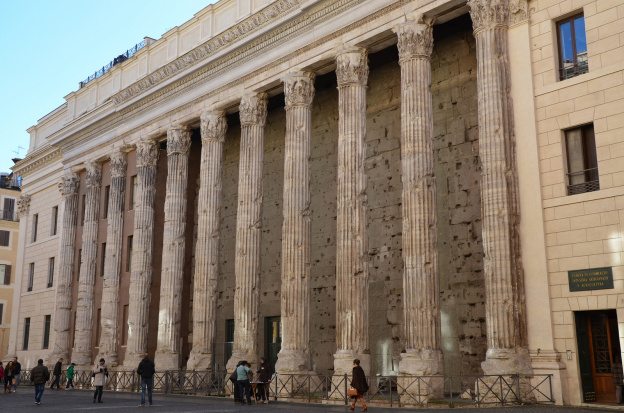
Just a short walk from the Pantheon in Rome, in Piazza di Pietra, are the majestic remains of the Temple of the deified Hadrian (Hadrianeum) built by Antoninus Pius, Hadrian’s adopted son and successor. Of the original temple, only eleven columns with capitals and the cella wall are still visible today. In 1696, during the…
-
Temple of Zeus, Euromos
—
by
The temple of Zeus Lepsynus at Euromos, located in the ancient region of Caria, is one of the best preserved temples in Turkey. The temple was built in the Corinthian order in the 2nd century CE (probably during the reign of the emperor Hadrian) on the site of an earlier Carian temple. Photo by Carole…