Author: Carole Raddato
-
Magnum incendium Romae (the Great Fire of Rome, 64 AD) — Nero the Arsonist on screen
This week marks the anniversary of the Great Fire of Rome, one of the worst disasters ever to hit the city of Rome. This tragic event took place during the reign of Nero in 64 A.D. The fire began in the merchant area of the city near the Circus Maximus and rapidly spread through the dry,…
-
The Labours of Hercules reliefs from the Villa Chiragan, Musee Saint-Raymond Toulouse (France)
In honour of Twitter’s international Museum Week (#MuseumWeek), I invite you today to discover some of my favourite sculptures from the collections of the Musée Saint-Raymond in Toulouse (France). The museum is among the best and richest archaeological museums in France and visitors can discover the Roman town of Tolosa (Toulouse in Roman times), the…
-
Art and sculptures from Hadrian’s Villa: Statue of the young god Hermes, known as ‘Capitoline Antinous’
This week’s sculpture from Hadrian’s Villa is a marble statue of a young nude, the so-called ‘Capitoline Antinous’. It was found in 1723/24 during the time when Giuseppe Fede was undertaking the earliest concerted excavations at the Villa Adriana. However its exact provenance within the Villa is unknown.
-
The Hadrianic aqueduct of Caesarea Maritima, Israel
Caesarea Maritima is perhaps one of Israel’s most famous attractions. Its ruins are located by the sea-shore of Israel about half way between Tel Aviv and Haifa. It is the site of one of the most important cities of the Roman World, the capital of the province of Judaea. The city was founded between 22 and 10…
-
A taste of Ancient Rome: Pullum Numidicum (Numidian Chicken) and Conchicla Cum faba (Beans with Cumin)
Ithas been over a year since I last blogged about ancient Roman cooking, even though I have tried a few more recipes in the meantime, as people who follow me on Twitter or Facebook have probably noticed. One of my last cooking sessions was on the occasion of Hadrian’s birthday on 24th January. Pullum (chicken)…
-
The Hadrianic Baths at Aphrodisias, Caria (Turkey)
The beautiful ancient Greek city of Aphrodisias, still partly excavated, is one of the most important archaeological sites of the late Hellenistic and Roman period in Turkey. The city was located in Caria in Asia Minor, on a plateau 600 meters above sea level. Today it lies near Geyre village, some 80 kilometers west of Denizli. The…
-
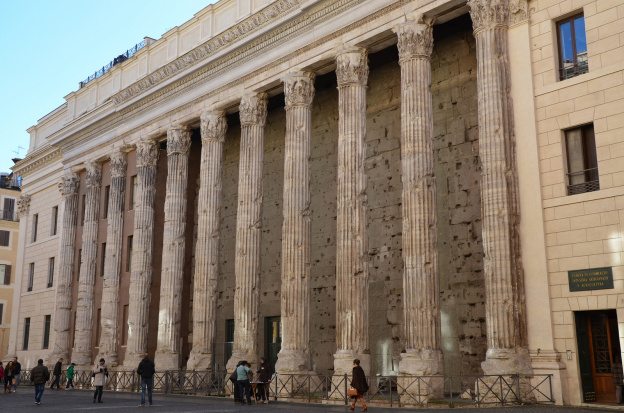
The Hadrianeum and the personifications of provinces
Just a short walk from the Pantheon in Rome, in Piazza di Pietra, are the majestic remains of the Temple of the deified Hadrian (Hadrianeum) built by Antoninus Pius, Hadrian’s adopted son and successor. Of the original temple, only eleven columns with capitals and the cella wall are still visible today. In 1696, during the…
-
Looking for Roman bridges in Sardinia
When I was planning my archaeological trip to Sardinia I discovered, thanks to vici.org (an Archaeological Atlas of Antiquity I have mentioned here before), that there were many Roman bridges still standing all across the country. Some are left abandoned and almost completely covered with vegetation but others are perfectly preserved. Ancient Roman bridges are an…
-
The Punic-Roman Temple of Antas, Sardinia
Nestled in the middle of the Iglesiente mountains in the southwestern part of Sardinia, the ruins of the Punic–Roman Temple of Antas offer visitors a truly majestic sight. After lying abandoned for centuries, the temple was discovered in 1838 and extensively restored in 1967. Most impressively, the original Ionic columns were excavated and re-erected. The…
-
The Byzantine “Bird Mosaic” from Caesarea, Israel
A stunning mosaic floor referred to as the “Bird Mosaic” was uncovered by accident in 1955 on the outskirts of Caeserea in Israel, outside the walls of the ancient settlement. With no budget available for its preservation, it was covered over again until the Israel Antiquities Authority and the Director of the Caesarea Antiquities Preservation…